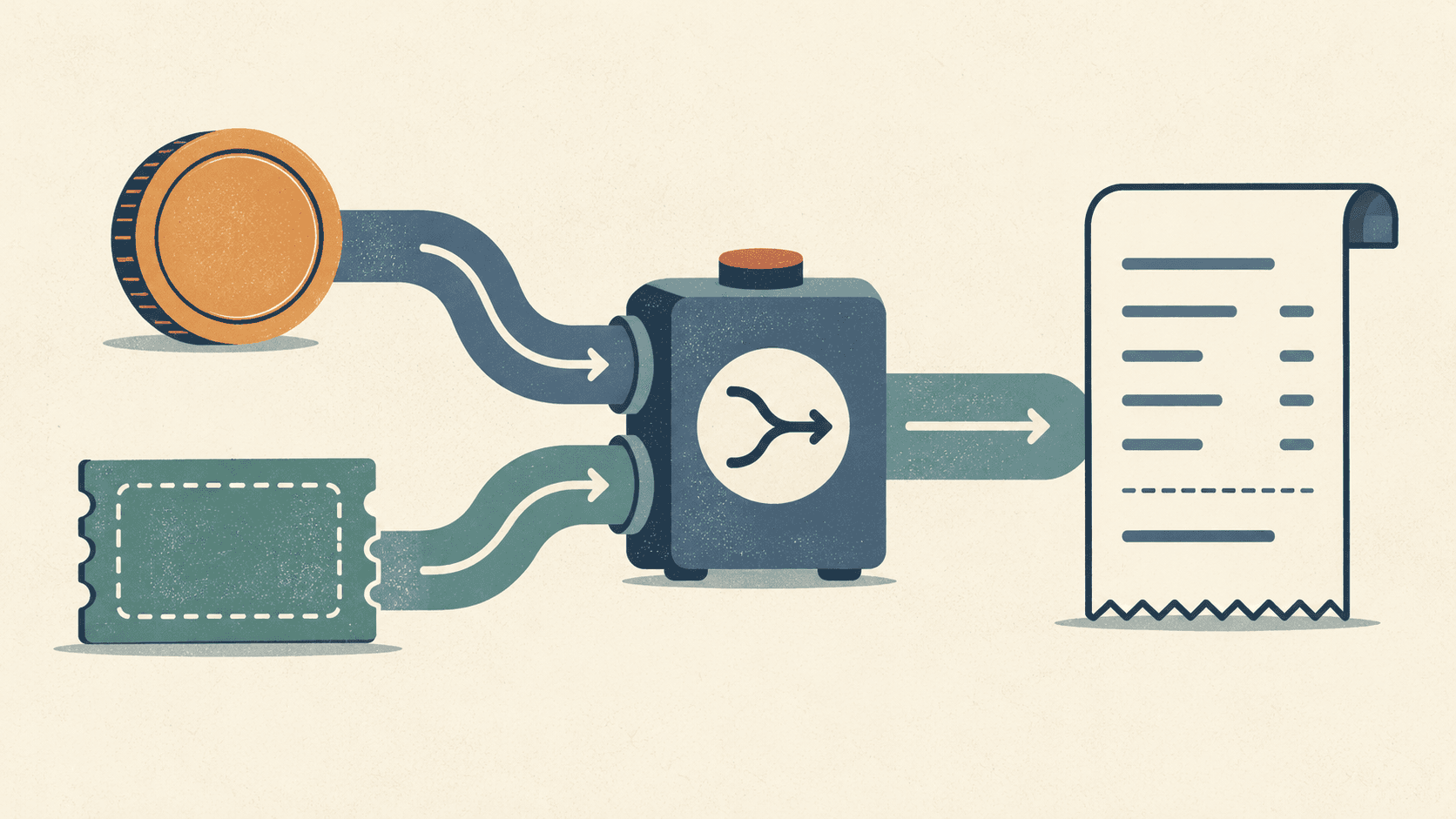
An illustration of the topic, rather than an actual product screenshot or exact architecture diagram.
Gathering field names in an enum did not guarantee the values attached to them. A caller could still pass a string as a price or combine incompatible props. I use satisfies, generics, and unions to catch those combinations where they are passed. With optional properties, I also look at which keys an object may omit, rather than only the type returned when reading them.
Checking compatibility with satisfies while preserving inference
For a route map, I want to check the required names without losing each concrete path. Here as const keeps the literals, while satisfies checks the required keys and path format.
type RouteName = 'home' | 'profile' | 'settings';

const ROUTES = {
  home: '/',
  profile: '/profile',
  settings: '/settings',
} as const satisfies Record<RouteName, `/${string}`>;

ROUTES.profile;
// '/profile'로 추론된다.
Annotating the variable as Record<RouteName, string> can make ROUTES.profile read as the broader string. The combination keeps '/profile' while catching missing keys and invalid paths. I use it for exhaustive label maps too, such as payment-method labels.
const LABELS = {
  normal: '일반 결제',
  coupon: '쿠폰 결제',
  // cancel 누락 시 컴파일 오류
} as const satisfies Record<'normal' | 'coupon' | 'cancel', string>;
T | undefined and an optional property mean different things
interface Example {
  requiredKey: number | undefined;
  optionalKey?: number;
}

const a: Example = {
  requiredKey: undefined,
};
Both properties can read as number | undefined, but constructing the object carries different requirements.
requiredKeymust exist, and its value may beundefined.optionalKeymay be omitted entirely.
exactOptionalPropertyTypes makes the distinction explicit. optionalKey?: number allows the key to be absent. Assigning undefined requires adding it to the value type as well.
JSON introduces another distinction: JSON.stringify omits object properties whose values are undefined. Keeping a key in a JavaScript object does not mean it will appear in the request body.
Connecting a value and its callback with a generic
interface SelectProps<T extends string> {
  value: T;
  onValueChange: (value: T) => void;
}

function Select<T extends string>({ value, onValueChange }: SelectProps<T>) {
  return <button onClick={() => onValueChange(value)}>{value}</button>;
}
This Select passes its value to the callback. Supplying PaymentMethod at the call site gives both props the same union and keeps that set of payment methods visible inside the callback.
type PaymentMethod = 'normal' | 'coupon';

<Select<PaymentMethod>
  value="coupon"
  onValueChange={(method) => {
    // method: 'normal' | 'coupon'
  }}
/>;
A single generic expresses that relationship instead of declaring each prop independently as string.
Expressing mutually exclusive props with a union
A component may support a value with a change callback, or just a label. Making every property optional would also permit a label and value together. I use never for the properties each mode must reject, so the union describes the allowed combinations.
type ControlledProps<T extends string> = {
  value: T;
  onValueChange: (value: T) => void;
  label?: never;
};

type LabelOnlyProps = {
  label: string;
  value?: never;
  onValueChange?: never;
};

type Props<T extends string> = ControlledProps<T> | LabelOnlyProps;

function Field<T extends string>(props: Props<T>) {
  if ('label' in props) return <span>{props.label}</span>;
  return <button onClick={() => props.onValueChange(props.value)}>{props.value}</button>;
}<Field label="읽기 전용" />; // 가능
<Field value="active" onValueChange={() => {}} />; // 가능
<Field label="잘못된 조합" value="active" />; // 컴파일 오류Function overloads are useful for describing call signatures. For modeling valid React props, a discriminated union or a never-based XOR also lets the implementation narrow the types safely.
In this example, an invalid combination fails where the component is called. The implementation can inspect the props and then read only the fields available for that mode.